Your spectacle prescription will contain all the values and information you need when ordering your spectacles. Prescriptions may differ depending on which optician you have visited. Your prescription should show the following basic values:
Intensity (power / sphere / spherical intensity)
Minus values refer to littittleness and plus values to sphericity.
Cyl/Cylinder value
The first value related to the correction of dispersion, the cylinder value, measures the amount of astigmatism, or dispersion. Note! The number showing the Cylinder Value is most often reported as negative, but if the Cylinder Value in your recipe is marked as positive, select a positive value.
Ax/Axis/Cylinder axis
The second value needed to correct for astigmatism is expressed as a number of degrees and indicates the position of the astigmatism in the eye. The Axis value indicates in which direction the refractive error is corrected. If you do not have astigmatism (diffraction error) the cylinder and axis values are blank.
Extra power/ADD
Value related to presbyopia, used in Progressive lenses. The added value is the difference between distance power and reading power in diopter units.
Interpupillary distance/PD/KV
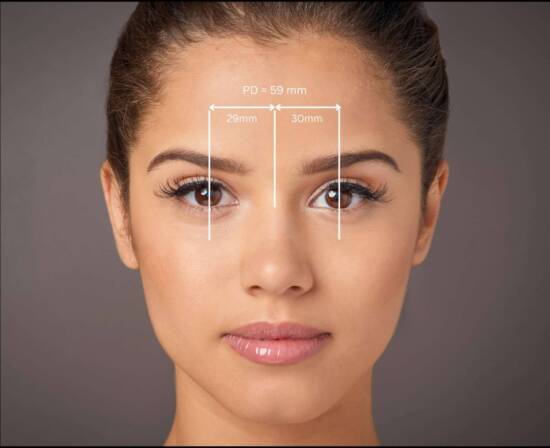
The PD value indicates the distance between the pupils in millimetres. The PD value determines the correct position of the optical centre of the lens.
If your prescription specifies only one value for the eye width (e.g. 60), divide this number by two. PD 60 should therefore be indicated as PD 30 (left eye = OS) and PD 30 (right eye = OD). If the PD value is given as two numbers, e.g. 66/63, the first value is for distance glasses and the second for near glasses.
Any other indications that may be found on your prescription:
Free vision Indicates the accuracy of your vision without correction, i.e. how well you can see without glasses.
Corrected vision Indicates your visual acuity with correction, i.e. how well you can see with glasses.